About Me

Welcome! I am Natalia, a computational astrophysicist specializing in high-resolution galactic-scale hydrodynamical simulations and their interpretation. My main interests include the formation and evolution of stars and star clusters in low-metallicity gas-rich environments that were prevalent in the early Universe. Currently I'm based at Astronomisches Rechen-Institut (ARI) in the Zentrum für Astronomie der Universität Heidelberg (ZAH) in Heidelberg, Germany, where I hold an independent Gliese Fellowship. In 2026 I will join Max Planck Institute for Astrophysics (MPA) in Garching near Münich, Germany, as the PI of the European Research Council funded project "ILMATAR". Previously, I held a 5-year independent post-doctoral fellowship at MPA. I received my PhD in 2020 at the University of Helsinki in Finland under the supervision of Peter H. Johansson. See my CV for more details and my ADS page for a complete list of publications.

ORCID iD: 0000-0003-2166-1935

Research

  • Star clusters in a galactic context

    Stars and star clusters form and evolve in a galactic ecosystem. My work concentrates on numerical simulations of galaxy evolution that reach the details of individual stars, run on supercomputers.

  • The GRIFFIN project

    The range of scales covered by the Galaxy Realizations Including Feedback From INdividual massive stars project would not be possible without an international group effort. Check the GRIFFIN project website!

  • Synthetic observations

    Simulated observations are more than pretty pictures. Post-processing the simulation data with radiative transfer methods and observational data analysis tools helps us find a common language between theoretical and observational astrophysicists.

A new research group at MPA

I was awarded an ERC Starting Grant in 2025 by the European Research Council. The 5-year project with an acronym ILMATAR will be initiated in 2026 at MPA where I will soon start as a group leader. If you are a post-doc or a student and would be interested in joining or closely collaborating with the group, see the MPA-website and the IMPRS call for job openings, or contact me directly for more details.

ILMATAR will explore star cluster formation and the origin of globular clusters in idealized and cosmological zoom-in simulations that include state-of-the-art methods for stellar evolution and small-scale gravitational dynamics. The aims of this project are to
1) quantify the birth-conditions of globular clusters in the clumpy structures observed in high-redshift galaxies
2) constrain the sources of chemical variations in globular clusters and high-redshift galaxies; estimate the contribution of proto-globular clusters to the reionisation of the Universe
3) quantify the role of proto-globular clusters as ideal locations to grow massive black hole seeds.


More details will follow!

Selected Publications

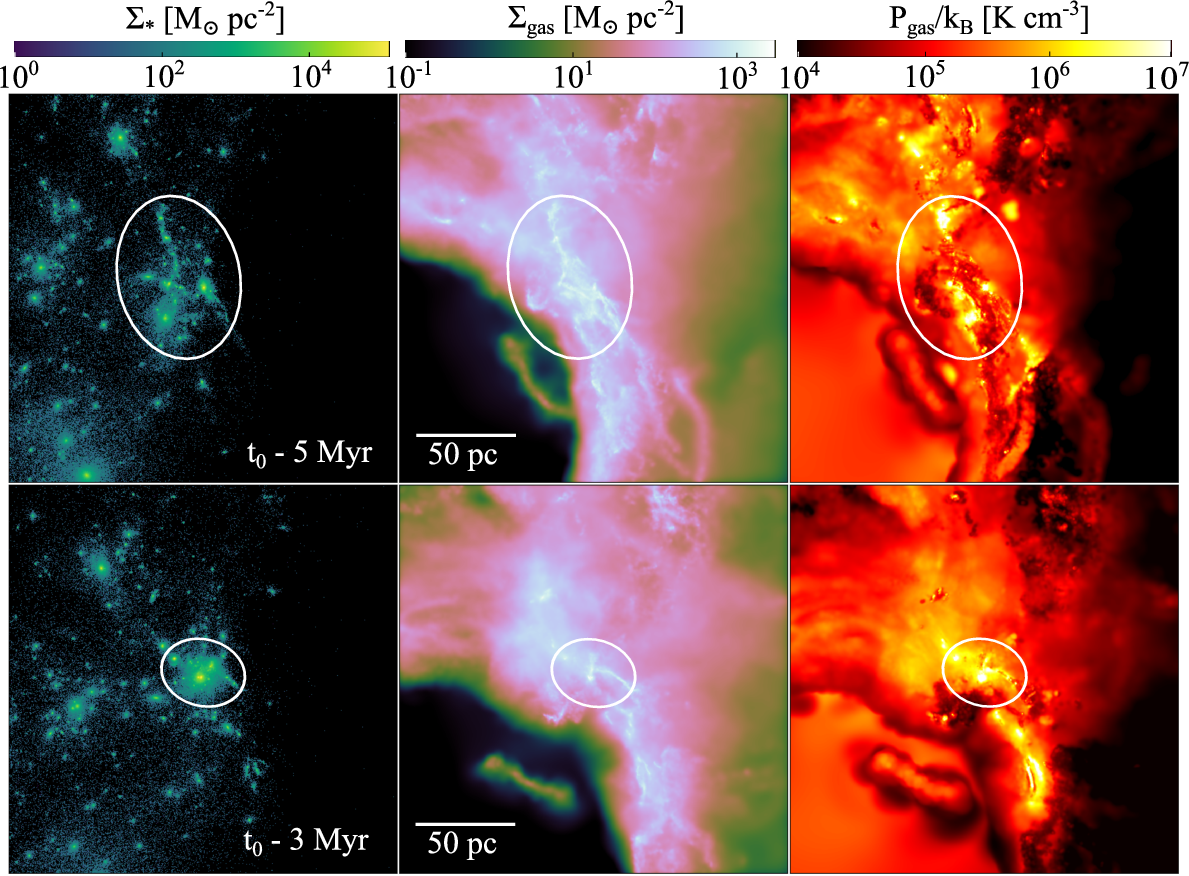
Mergers all the way down: stellar collisions and kinematics of a dense hierarchically forming massive star cluster in a dwarf starburst
Lahén, N., Naab, T., Rantala, A., Partmann, C.
The formation, evolution, and disruption of star clusters with improved gravitational dynamics in simulated dwarf galaxies
Lahén, N., Rantala, A., Naab, T., Partmann, C., Johansson, P. H., Hislop, J. M.
Star clusters forming in a low-metallicity starburst - rapid self-enrichment by (very) massive stars
Lahén, N., Naab, T., Szécsi, D.
Formation of star clusters and enrichment by massive stars in simulations of low-metallicity galaxies with a fully sampled initial stellar mass function
Lahén, N., Naab, T., Kauffmann, G., Szécsi, D., Hislop, J. M., Rantala, A., Kozyreva, A., Walch, S., Hu, C.-Y.
A panchromatic view of star cluster formation in a simulated dwarf galaxy starburst
Lahén, N., Naab, T., Kauffmann, G.
Structure and Rotation of Young Massive Star Clusters in a Simulated Dwarf Starburst
Lahén, N., Naab, T., Johansson, P. H., Elmegreen, B., Hu, C.-Y., Walch, S., 2020, ApJ
The GRIFFIN Project—Formation of Star Clusters with Individual Massive Stars in a Simulated Dwarf Galaxy Starburst
Lahén, N., Naab T., Johansson, P. H., Elmegreen, B., Hu, C.-Y., Walch, S., Steinwandel, U. P., Moster, B. P., 2020, ApJ
The Formation of Low-metallicity Globular Clusters in Dwarf Galaxy Mergers
Lahén, N., Naab T., Johansson, P. H., Elmegreen, B., Hu, C.-Y., Walch, S., 2019, ApJ
The fate of the Antennae galaxies
Lahén, N., Johansson, P. H., Rantala, A., Naab, T., Frigo, M., 2018, MNRAS

Research highlights and other texts

How did the oldest star clusters form? by N. Lahén in Nature News & Views
Galaxy Evolution Including Multiphase Interstellar Medium, Individual Stars and Massive Black Holes by N. Lahén, C. Partmann, Eds. P. Bastian, D. Kranzlmüller, H. Brüchle, and G. Mathias in SuperMUC-NG Highlights book: High Performance Computing in Science and Engineering – Garching/Munich 2024
Simulating the birth, life and dispersal of galactic star clusters by N. Lahén, T. Naab in MPA Research highlights
How do star clusters form in dwarf galaxies? by N. Lahén, J. M. Hislop, T. Naab, and G. Kauffmann in MPA Research highlights
Globular cluster formation deciphered by T. Naab in MPA Research highlights
Featured Image: Growing Globular Clusters from Mergers by S. Kohler in AAS Nova